“Door lock with security chain”
September 4, 2026
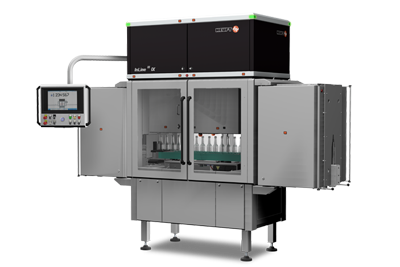
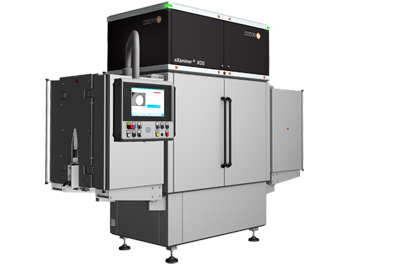
Double protection thanks to a combination of high-performance optics and pulsed X-rays. Significantly greater detection reliability and assessment power with deep learning AI. Increased line efficiency through more stable processes. In this interview, Kristina Moers, Sjoerd Van Laar, and Rudolf Hilt – who manage HEUFT’s products for empty bottle inspection, full container inspection, and foreign object detection – discuss the state of the art in in-line quality assurance for the bottling process of beer and other beverages.

Sjoerd Van Laar, Rudolf Hilt, and Kristina Moers (from left to right) from HEUFT Product Management.
How important is suitable inspection equipment in the bottling process?
Sjoerd Van Laar: “Inspection systems are of central importance to breweries because they ensure that only flawless products reach the market. They detect foreign objects, glass defects and filling and capping faults, thereby reducing the risk of product recalls and legal consequences. At the same time, modern in-line inspection systems stabilise the bottling process: real-time results enable defective products to be rejected immediately. Important data is also generated that can be transmitted and analysed in real time. This enables, for example, filler closer management for the preventive maintenance of filling valves and closure heads, which reduces scrap as well as downtime and increases plant availability. Furthermore, inspection systems fulfil a strategic function. Many trading partners and export markets demand clear proof of quality – reliable inspection thus opens the door to new sales channels. Consistent quality also strengthens consumer confidence and protects the brand from reputational damage. The image and process data generated during in-line inspection form the basis for modern analyses and AI models, which lead to even more precise defect detection in the long term.”
Rudolf Hilt: “A master brewer once put it very aptly: ‘Ever since I’ve had the HEUFT inspector, I’ve been able to sleep soundly at night.’ That is exactly what these systems are all about: they provide peace of mind – for producers, retailers and consumers alike – and are therefore a genuine investment in quality, efficiency and future-proofing.”
A good night’s sleep – which detection technologies contribute most to this?
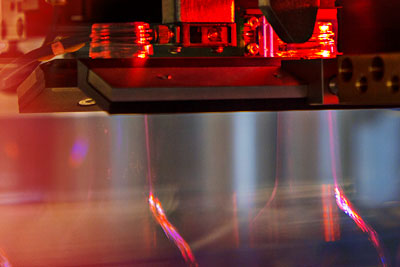
Kristina Moers: “Although camera-based systems and sensors still account for the largest share, we are seeing a clear trend towards X-ray inspection. Cameras and sensors are the first choice for detecting surface defects, geometric deviations or contamination. However, their limitations become apparent where liquid residues in empty bottles obscure optical features or where no visible anomaly is present – even AI cannot deduce anything from an image that is not physically visible. If, for example, you want to reliably detect glass, metal or stone particles in the empty containers or in the filled product, there is no alternative to X-ray technology.”
Can HEUFT’s pulsed X-ray technology completely replace camera-based inspection?
Kristina Moers: “Optical inspection systems offer numerous advantages over conventional, non-pulsed X-ray technology: high efficiency, precise image quality and very fast processing on the production line. With our pulsed X-ray technology, many of these strengths can now also be applied to X-ray inspection. The short pulses reduce the need for radiation protection, enable extremely short ‘exposure times’ and ensure consistently high image quality even at high and variable speeds.
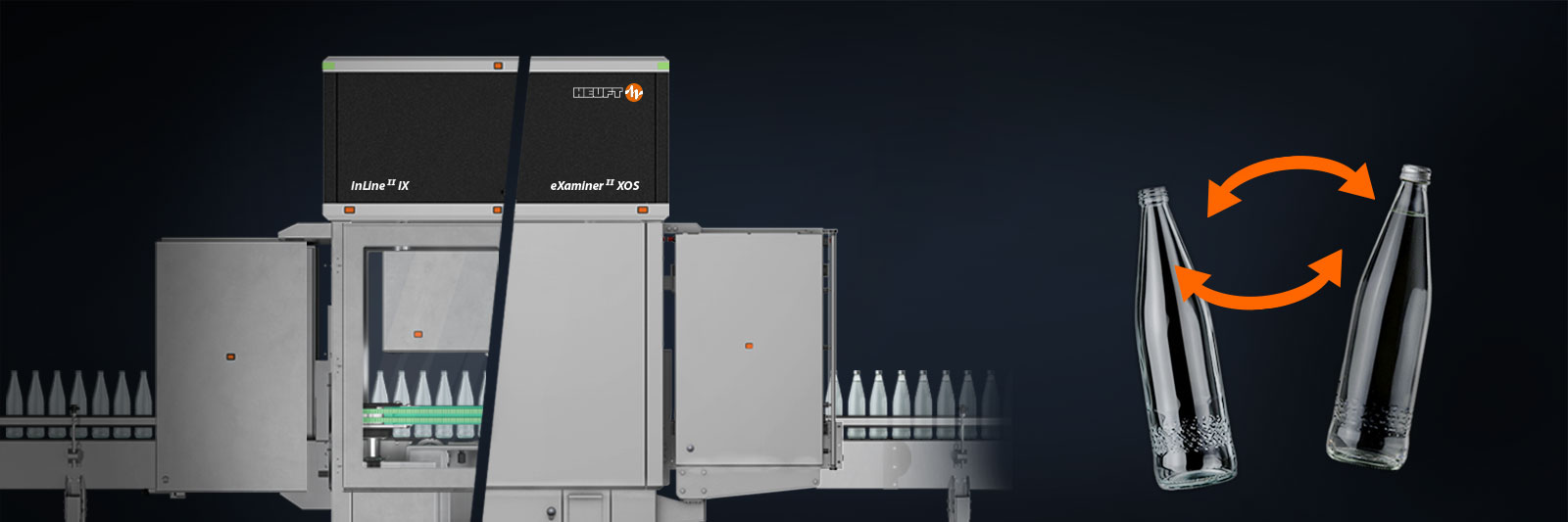
Rudolf Hilt: “This makes pulsed X-ray inspection an ideal complement to optical inspection – particularly for critical faults such as glass-in-glass. You could say: optical inspection is the door lock that closes reliably. Pulsed X-ray technology is the security chain that provides additional protection when particular risks exist.”
So, it’s about redundancy, about providing additional protection for consumers and the brand. Are there any further advantages, and how high is the demand for X-ray-assisted systems for empty and full container inspection?
Rudolf Hilt: “The international comparison is particularly interesting: in many foreign markets, the use of X-ray inspection systems is already significantly more widespread than here in Germany. Anyone investing in modern inspection technologies today is not only ensuring additional product safety, but is also positioning themselves to meet future quality requirements and international competitive standards.”
This certainly also applies to the processing of the images captured. What’s new in this area?
Sjoerd Van Laar: “In addition to sophisticated camera technology and pulsed X-ray inspection, we are increasingly using deep learning AI. This enables us to manage manufacturing tolerances, natural process fluctuations and the wide variability of different bottle batches much more robustly, without compromising inspection reliability. Otherwise, image processing is currently evolving in several directions: faster evaluation processes, higher image quality, ease of use and significantly reduced commissioning times. At the same time, requirements are increasing – not least due to the ‘Beyond Beer’ concept, which is leading to ever more diverse product portfolios: new bottle shapes, complex embossings, innovative packaging and adjacent markets beyond the traditional brewery sector. It is often underestimated just how crucial the further development of hardware remains: precise image capture forms the basis for reliable detection and is a key determinant of the performance of modern inspection systems. To be able to shape our own technological foundation, we are driving forward the development of our own state-of-the-art camera systems. Our aim is to become independent of individual suppliers in a dynamic market environment and to actively influence innovation.